Short answer
To send a wire transfer, enroll in your bank’s online wires (or go to a branch with photo ID), add the recipient’s name and address, their bank’s name, the bank’s wire routing number and the account number, then confirm with a one-time code. Expect to pay $25 to $30 online at the three biggest banks. A domestic wire sent before your bank’s cutoff usually arrives the same business day, and once it is sent it is very hard to get back.
On this page
At a glance
- Domestic wireRecipient’s name and address, bank name, wire routing number (ABA), account number
- International wireThe same, with the bank’s SWIFT/BIC code and often an IBAN or a local bank code
- Online fee$25 at Chase, $30 at Bank of America and Wells Fargo for a domestic wire
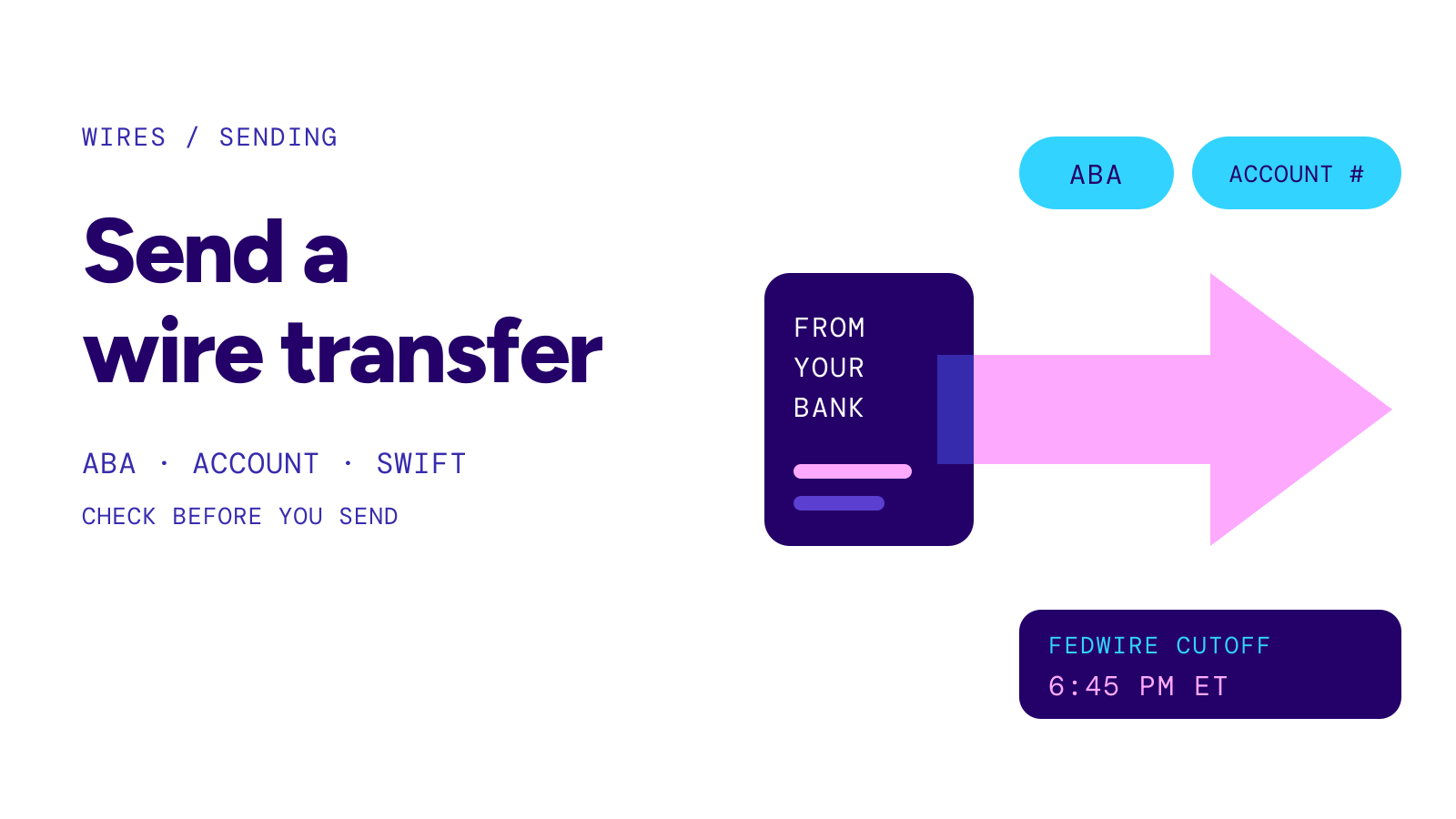
- Fedwire hours9:00 PM ET the evening before to 7:00 PM ET; last call for customer wires 6:45 PM ET; business days only
- CancelInternational consumer wires usually within 30 minutes; same-day domestic wires usually not at all
Sources: Federal Reserve Financial Services: Fedwire operating hours · Chase: Wire transfer FAQs · Wells Fargo Digital Wires · Checked on October 21, 2026
Before you start
A wire is a bank-to-bank payment: your bank sends the money to the recipient’s bank, and for a domestic wire the Federal Reserve’s Fedwire service settles it between the two. You need an account that can send wires and a way to confirm your identity.
- Online: Most large banks ask you to enroll first. Wells Fargo requires a valid U.S. mobile number or an RSA SecurID device, and a current residence in the United States; customers living in U.S. territories or abroad can’t send wires online. Bank of America asks for your debit card number and PIN, plus a U.S. mobile number or a USB security key.
- At a branch: Chase asks you to bring a photo ID and your mobile phone. A branch wire costs more, but it is also the way to send more than your online limit at Wells Fargo.
- Account type: Not every account can send. Chase says Chase Secure Banking accounts can receive wires but not send them, and Chase First Banking accounts can’t use wires at all.
The details you need from the recipient
Get these from the person you are paying, over a channel you started, and copy them exactly:
- The recipient’s full name and address, as their bank has them.
- Their bank’s name (and its address, for international wires).
- The wire routing number (ABA) for a domestic wire. Bank of America warns that some banks use different routing numbers for wires and ACH, and a wrong number may cause the wire to be delayed, rejected, returned or sent to the wrong account.
- The account number, in full.
- For an international wire: the bank’s SWIFT/BIC code and, in many countries, an IBAN. Wells Fargo lists other codes some countries require: a BSB in Australia, a Canadian payment routing number, a U.K. sort code, an IFSC code in India and a CLABE in Mexico. Some countries also require a purpose of payment.
The person receiving the money can use our guide on how to receive a wire transfer to find the right details on their side.
Warning
Wiring money is like sending cash: once the money reaches the other account, your bank may not be able to get it back. Never wire money to someone you have not met, and if you receive new or “updated” wire instructions by email or text, for a home closing, an invoice or a family emergency, call a phone number you already had before you send anything.
How to send a wire, step by step
At Wells Fargo the online steps are typical:
- Sign on and choose Transfer & Pay, then Wire Money.
- Add the recipient and their bank details. Wells Fargo saves a recipient after the first wire.
- Choose the account to pay from, the amount and, for an international wire, whether to send U.S. dollars or the foreign currency.
- Review the fee and, for a wire abroad, the exchange rate and the amount the recipient will get.
- Confirm with the code sent to your phone or security device, and keep the confirmation.
At Bank of America the wire is in the Pay & Transfer menu, where you can also check its status later. At Chase, you see your daily wire limit before you add a recipient.
What it costs to send a wire
| Bank | Domestic, online | International, online |
|---|---|---|
| Chase | $25 | $40 in U.S. dollars; $5 in a foreign currency, $0 at $5,000 or more |
| Bank of America | $30 | $45 in U.S. dollars; no wire fee in a foreign currency |
| Wells Fargo | $30 | $30 |
Sources: Chase Additional Banking Services and Fees · Bank of America: Wire transfers · Wells Fargo Digital Wires · Checked on October 21, 2026
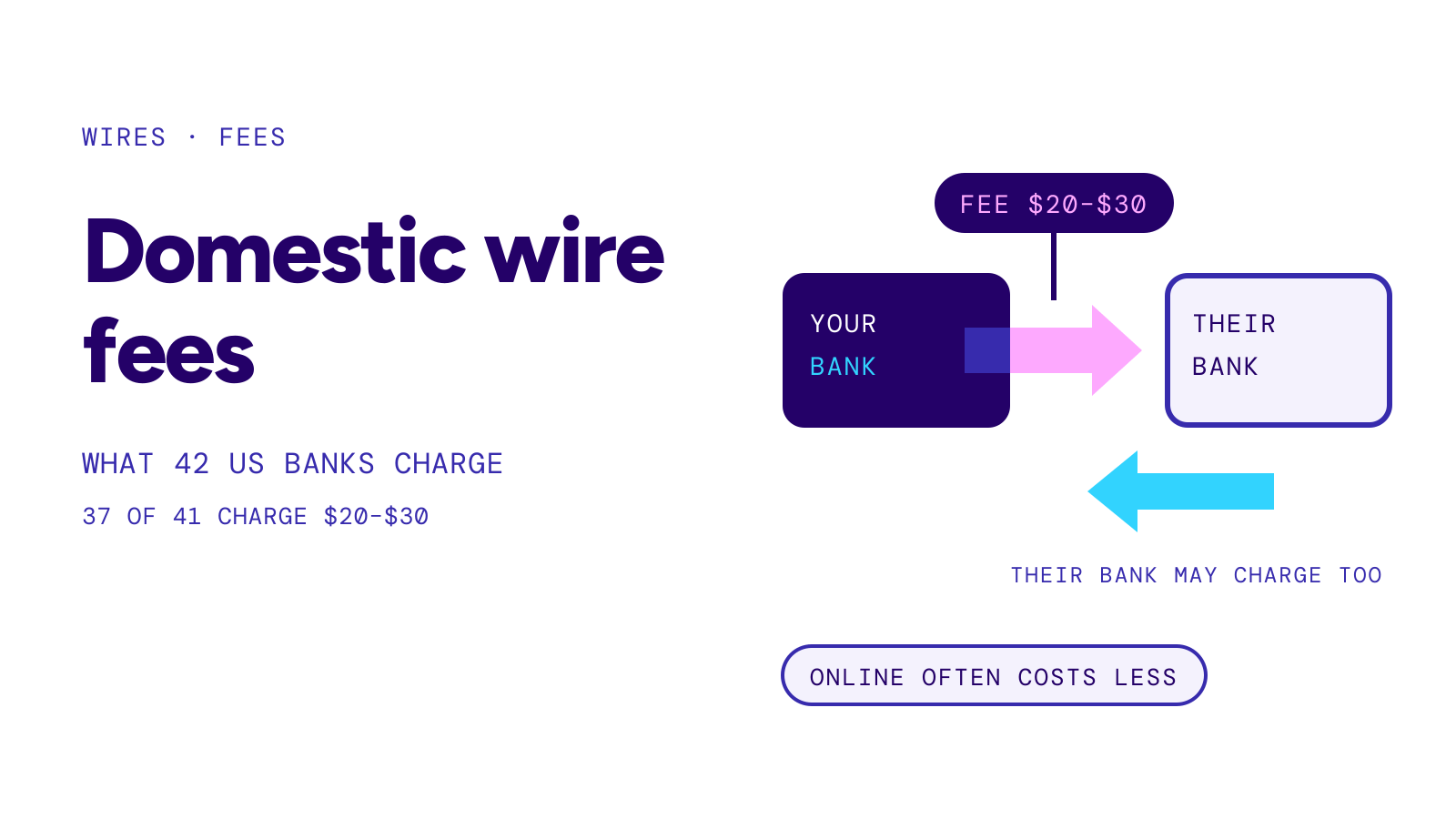
A wire in a foreign currency is not free just because the wire fee is low or zero. Bank of America and Wells Fargo both say they make money on the exchange rate, which includes a markup. With a banker, Chase charges $35 for a domestic wire and $50 for an international one in U.S. dollars; Wells Fargo charges $40 for a branch wire. Banks along the way can also take their own charges out of the amount, so the recipient may get less than you sent. Federal law sets no maximum wire fee, according to the OCC’s HelpWithMyBank. The domestic wire transfer fee at 42 banks and credit unions is in our fee table. For fees abroad, see international wire transfer fee, and for a side-by-side with a cheaper option, ach vs wire transfer.
Limits
Banks cap online wires. Bank of America’s online banking agreement sets $1,000 per transaction for consumer accounts, and it asks customers to use its Secured Transfer service above the limit for their account type. Wells Fargo sets a daily limit and a rolling 30-day limit based on your account, history and recipient, and sends you to a branch for more. Chase shows your limit in the app before you add a recipient.
When the money arrives
Timeline
- Before your bank’s cutoffyour bank sends the wire the same business day. Bank of America’s cutoff is 5:00 PM ET; Wells Fargo’s for domestic digital wires is 3:00 PM PT (6:00 PM ET). Other banks are in wire transfer cutoff time.
- Fedwire open, 9:00 PM ET the evening before to 7:00 PM ETthe Federal Reserve moves a domestic wire to the recipient’s bank. Its last call for customer transfers is 6:45 PM ET.
- Same business daya domestic wire typically reaches the recipient’s bank the day it is sent.
- One to five business daysBank of America’s estimate for an international wire, which may pass through intermediary banks.
Wires don’t move on Saturdays, Sundays or Federal Reserve holidays; a wire you submit then goes out on the next business day. The dates are in federal reserve holidays 2026.
Canceling, mistakes and problems
Act quickly. Chase does not let you cancel a same-day domestic wire; you can cancel a future-dated one until 11:59 PM ET the day before it is sent. Most international wires a consumer sends are remittance transfers, which the CFPB says can be canceled within 30 minutes of payment, and you have 180 days to report an error such as a wrong amount. The steps are in cancel international money transfer.
Domestic wires have fewer protections: Regulation E, the federal rule for electronic transfers, excludes transfers through Fedwire or similar wire systems used mainly between banks and businesses. If a wire went to the wrong account or to a scammer, contact your bank at once and ask it to request a recall from the receiving bank; HelpWithMyBank also suggests reporting fraud to the FTC and the FBI’s IC3. When a recall can work, and when it can’t, is explained in can a wire transfer be reversed. If a wire you sent is late, start with wire transfer not received.
For more on a specific bank, see Chase wire transfer, Bank of America wire transfer, wells fargo wire transfer routing number, navy federal wire transfer, usaa wire transfer and capital one wire transfer. If a wire is more than you need for a large payment, compare wire transfer vs cashier’s check.