Short answer
If a wire transfer is not received, check the basics first: was it sent before the bank’s cutoff, on a business day, and has the bank actually released it? A domestic wire sent before the cutoff usually lands the same business day. If it has not, the sender asks their bank to trace it using the Fedwire references (IMAD and OMAD), or the UETR for an international wire.
On this page
Only the sender’s bank can trace or recall a wire it sent. The recipient’s job is to confirm the details they gave and to ask their own bank whether a wire with those references has arrived.
At a glance
- Domestic wire sent before the cutoffUsually the same business day
- Fedwire deadline for customer transfers6:45 PM ET
- Weekends and Federal Reserve holidaysFedwire closed
- International wireCapital One says up to 10 business days to be deposited
- Domestic reference numbersIMAD and OMAD
- International reference numberUETR
- Time to report an international (remittance) error180 days from the disclosed availability date
Sources: Federal Reserve Financial Services: Fedwire operating hours, Fedwire Funds Service, Capital One wire support, CFPB: remittance rights · Checked on September 27, 2026
What a normal wire looks like
Timeline
- Before your bank’s cutoffyou request a domestic wire
- Same business dayyour bank finishes its checks and sends it over Fedwire, which takes customer transfers until 6:45 PM ET
- Same business daythe recipient’s bank receives the Fedwire message, which carries an IMAD and an OMAD
- When the receiving bank posts itthe money is in the recipient’s account
Capital One, as a receiving bank, says domestic wires received by 5:00 PM ET are deposited and made available the same business day. A wire requested on a Friday evening or on a Federal Reserve holiday waits for the next business day. For timing by bank, see How long do wire transfers take.
Check these first
The status in the sender’s app. Wells Fargo explains its own wire statuses, and they show where things stand:
| Status | What Wells Fargo says it means |
|---|---|
| Scheduled | Not processed yet; can still be canceled |
| Pending | In process; can no longer be canceled |
| Under review | Extra verification for your security |
| Completed | The wire was sent |
| Failed | Could not be sent; money goes back to your account |
| Returned | The recipient’s bank did not accept it; money goes back to your account |
| Canceled | It will not be sent |
Source: Wells Fargo: Digital wires FAQs · Checked on September 27, 2026
“Completed” means your bank sent it, not that the recipient’s bank has posted it.
A security review. Wells Fargo says a wire may go through an internal review before it is sent, and the bank may contact you to verify it. Answer those calls or messages quickly.
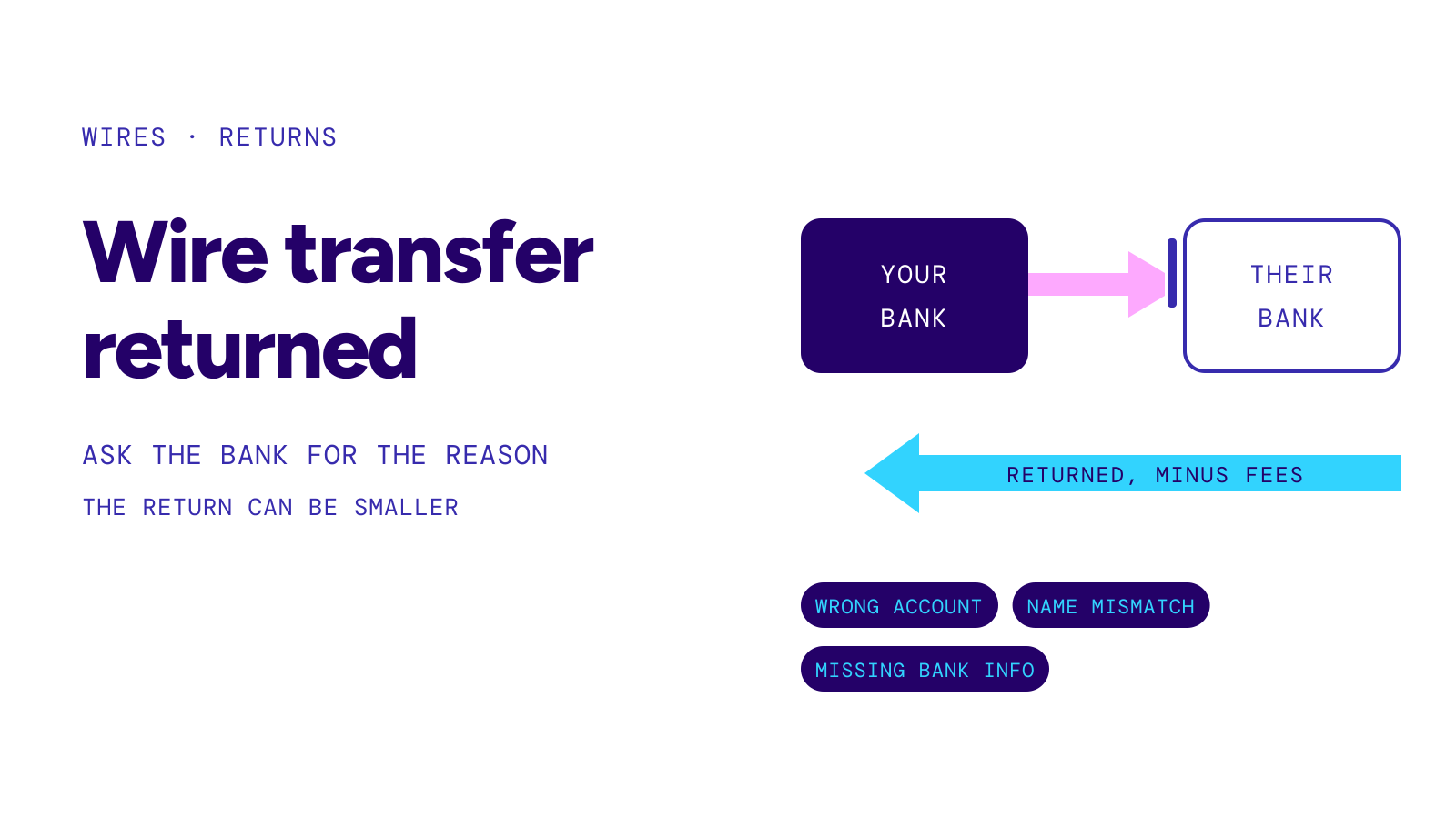
The recipient’s details. Chase lists common reasons a wire comes back: a wrong account number, missing bank or country information (for example, a payment purpose for an international wire), a message that conflicts with bank records, or a recipient name that does not match the receiving bank’s records.
A partial amount. A returned wire can come back smaller. Chase and Wells Fargo both say other banks may deduct fees, and a foreign currency wire converted back to dollars can lose value if the exchange rate moved.
What the sender can ask their bank for
| Request | Domestic wire (Fedwire) | International wire |
|---|---|---|
| Reference to quote | IMAD and OMAD | UETR, or your bank’s reference |
| Proof it arrived | The bank can send a Fedwire investigation request | Tracker status, where your bank offers one |
| Getting money back | A return request (recall); not guaranteed | A return request (recall); not guaranteed |
| Cancel window | Chase: same-day wires cannot be canceled | 30 minutes after paying, for remittance transfers |
| Formal error rights | Not covered by Regulation E | Regulation E remittance rules: 180 days to report |
Sources: Federal Reserve Financial Services: Fedwire Funds Service, Wells Fargo Payment Tracker, Chase: wire FAQs, CFPB: remittance rights, CFPB: Regulation E § 1005.3 · Checked on September 27, 2026
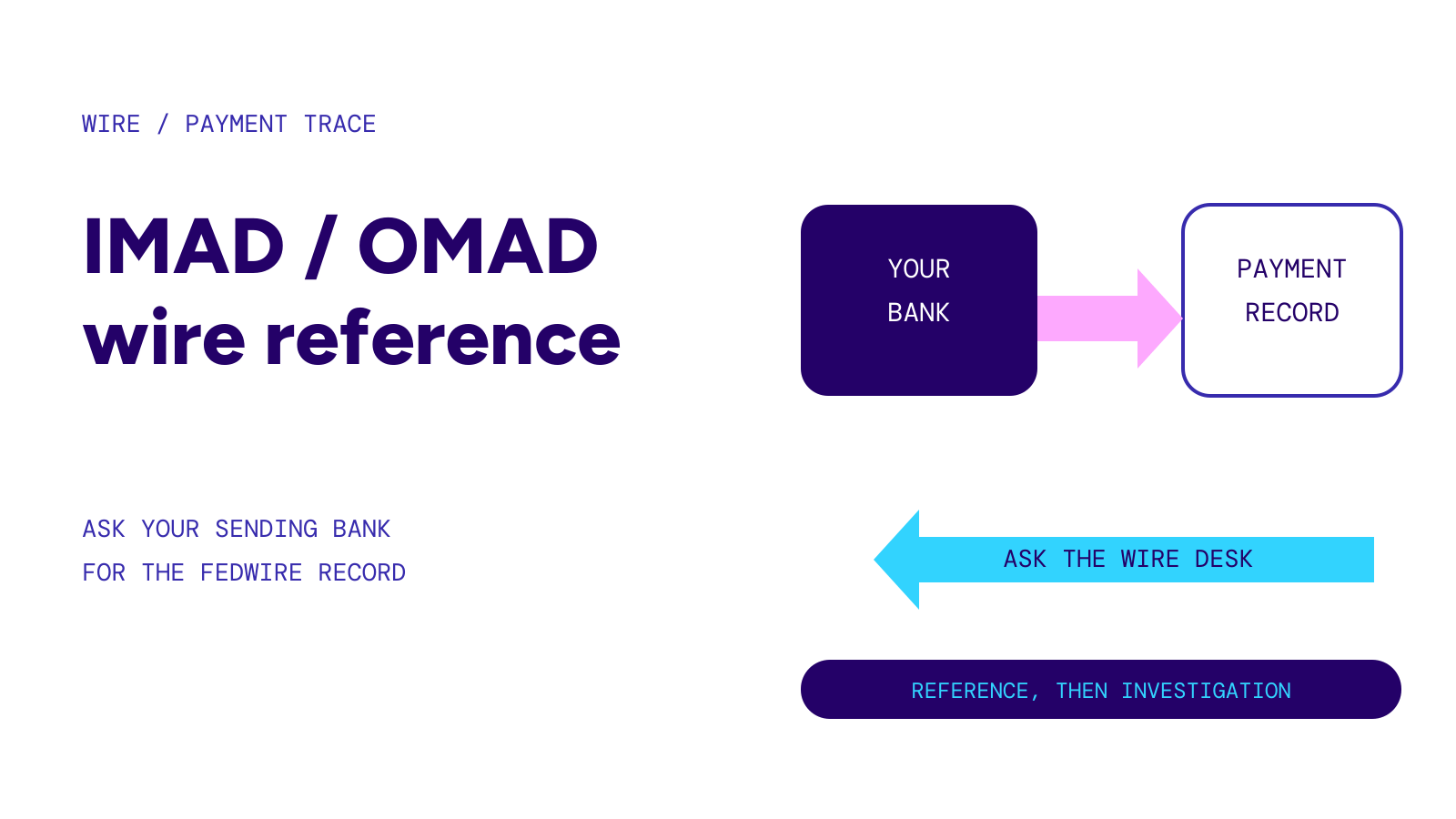
A trace, domestic. The Federal Reserve says every successfully processed Fedwire message carries an Input Message Accountability Data (IMAD) and an Output Message Accountability Data (OMAD) identification. They are how a bank confirms a wire was sent. Ask your bank for both and pass them to the recipient, so their bank can match the payment. Banks can also send a Fedwire investigation request to confirm that a wire was received and credited.
A trace, international. International wires that travel over the SWIFT network use a UETR, which Wells Fargo describes as the SWIFT payment unique end-to-end transaction reference number. Wells Fargo’s Payment Tracker, for example, looks up the status of certain international wires by the full UETR or the Wells Fargo reference number. Ask your bank for the UETR and whether it can see where the payment is.
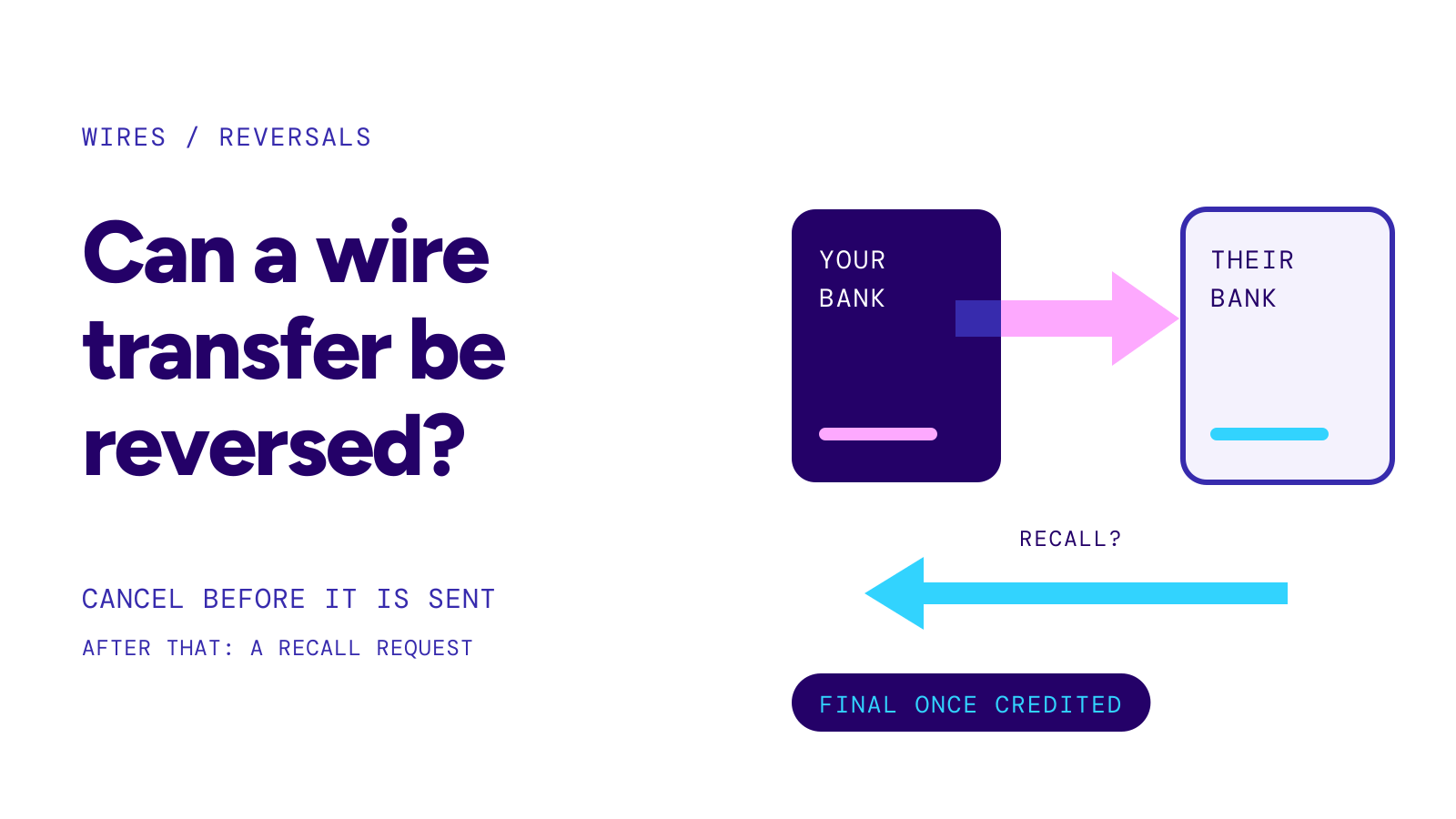
A recall. Through Fedwire, a bank can send a return request asking for the amount of the original wire back. It is a request, not a guarantee. Chase warns that recovery is very unlikely if you sent money by mistake or because of a scam.
Your rights when an international wire is late
Federal law calls most international wires sent by consumers “remittance transfers”: electronic transfers of more than $15 sent from the U.S. to someone abroad through a remittance transfer provider. Banks count as providers unless they sent 500 or fewer such transfers in both the prior and the current year.
Money that is not delivered by the date on your receipt, or that goes to the wrong account, is an error under the CFPB’s rules. What you can do:
- Report it within 180 days of the date the receipt said the money would be available. Tell the provider as soon as you can.
- The provider must investigate within 90 days and tell you the result within three business days after that.
- If money never arrived, you can generally choose a refund or have the transfer sent again at no extra cost, and fees are refunded for this kind of error.
- Exceptions exist. A delay is not an error if it comes from fraud or sanctions screening the provider could not foresee, or from extraordinary events such as natural disasters. If you gave a wrong account number or bank code, the provider may not have to refund you, as long as it took the steps the rule requires.
- If you are not satisfied, you can submit a complaint to the CFPB.
Domestic wires follow different rules
Regulation E, the federal rule for electronic transfers, excludes transfers through Fedwire or similar wire systems used mainly between banks or businesses. CFPB commentary points to Article 4A of the Uniform Commercial Code and the Federal Reserve’s Regulation J instead. In practice, your wire agreement with the bank sets most of the terms. Call the bank’s wire team, not general support, and ask for a trace in writing.
Warning
A wire sent to a scammer is very hard to get back. The CFPB warns about emails with last-minute changes to wiring instructions, especially before a home closing. Confirm instructions in person or by a phone number you agreed on earlier, never from the email itself. If you think you wired money to a scammer, call your bank right away, ask for a wire recall, and file a complaint with the FBI’s Internet Crime Complaint Center at ic3.gov. Be wary of anyone who offers to “recover” the money for a fee.
Read next: International wire transfer fees and ACH vs wire transfer.