Short answer
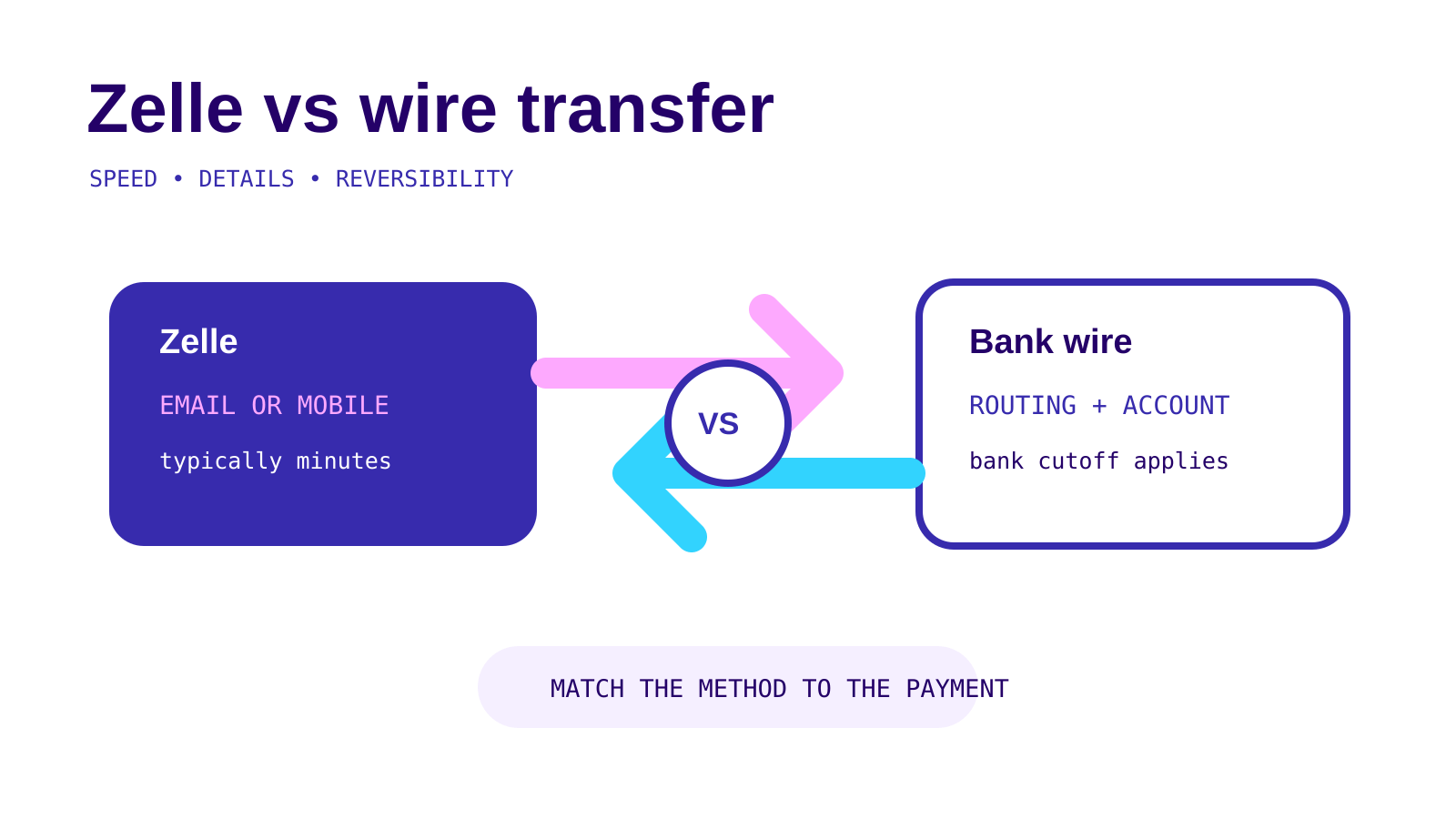
Zelle is usually the simpler choice for a personal payment to someone you know: it uses an email address or U.S. mobile number and normally lands within minutes when the recipient is enrolled. A bank wire is built for sending directly to a bank account, can carry larger or time-sensitive payments, and follows the sending bank’s fee and cutoff rules.
On this page
Zelle and a wire transfer both move money between banks, but they ask for different recipient details and solve different problems. Choose by looking at the recipient, amount, deadline, cost and what can happen if you enter the wrong information.
At a glance
Zelle Bank wire Recipient details Enrolled email address, U.S. mobile number or supported Zelle tag Recipient name, bank routing information and account number; international wires need more Typical speed Minutes to an enrolled recipient Often same business day domestically if the bank accepts it before its cutoff Service hours The experience is available through the participating bank’s app or online banking Fedwire processes on funds-transfer business days; each bank sets an earlier customer cutoff Fee Typically no consumer fee, but the bank decides The sending bank normally charges its published wire fee; receiving or intermediary fees may apply Cancellation A completed payment to an enrolled recipient cannot be canceled A bank may stop a wire before sending it; after transmission, recovery depends on a recall and the receiving side Sources: Zelle Help Center and Federal Reserve Financial Services · Checked on October 28, 2026
Use Zelle for a trusted person already in the network
Zelle works inside the mobile app or online banking service of participating banks and credit unions. The recipient is identified by an enrolled email address, U.S. mobile number or, where supported, a Zelle tag. The service says both parties need eligible U.S. bank accounts.
For an enrolled recipient, Zelle says the money is typically available within minutes. If the person is not enrolled, Zelle sends an invitation. The recipient has 14 days to enroll; otherwise, the payment expires and returns to the sender.
That makes Zelle practical for rent between roommates, paying back a friend or sending money to a relative you know. It is a poor fit when you cannot independently confirm who controls the email address or mobile number.
Warning
A completed Zelle payment to an enrolled recipient cannot be canceled or reversed through the normal payment flow. Before sending, confirm the displayed recipient name and the contact detail outside the payment app.
For a step-by-step recipient check, read how to receive money with Zelle. If a payment is still pending, use the Zelle payment pending guide.
Use a wire when bank-account delivery matters
A wire goes to the recipient’s bank using account and routing information. Domestic wires commonly use Fedwire behind the scenes, although the customer gives the instruction to a bank rather than to the Federal Reserve.
The Federal Reserve’s published Fedwire schedule runs from 9:00 PM ET on the preceding calendar day to 7:00 PM ET on each funds-transfer business day. The customer-transfer cutoff is 6:45 PM ET. Those are network hours, not a promise that your bank accepts customer instructions until 6:45 PM. Banks set their own earlier cutoffs and may use different cutoffs by channel.
A wire can fit a property closing, a large invoice or a payment where the recipient specifically gives bank instructions. It also creates more opportunity for an account-number mistake, so compare the instructions with a trusted document or a phone number you already know.
See how to send a wire transfer for the complete information checklist. The wire transfer cutoff table records the times banks publish.
Compare the real cost before choosing
Zelle says consumers typically pay no fee to send or receive money, but it tells users to confirm with their financial institution. Its Q1 2026 survey says 99.40% of linked consumer checking and savings accounts did not charge a fee for sending, receiving or requesting money.
A wire fee belongs to the bank’s account schedule. Some banks charge different amounts online and in a branch, and an incoming or intermediary fee can reduce what the recipient receives. Read the exact account schedule rather than assuming one bank’s price applies to another.
The domestic wire transfer fee guide compares current published prices. For an international payment, start with international wire transfer fees.
Treat finality as part of the decision
Zelle’s help center says a payment can be canceled only while the recipient has not enrolled. Once it is completed to an enrolled recipient, the money is already in that recipient’s bank account.
A wire is also difficult to recover after it leaves the sending bank. The sender can ask for a recall, but the request does not guarantee that the receiving bank or recipient will return the funds. The practical protection is to verify the instructions before authorizing the payment.
If you just sent a wire and found a mistake, read can a wire transfer be reversed? and contact the sending bank immediately.
A decision checklist
Choose Zelle when all of these are true:
- you know and trust the recipient;
- you have confirmed the enrolled email address, mobile number or tag;
- the amount is within your bank’s Zelle limit; and
- the recipient wants the money in the bank account tied to that Zelle profile.
Choose a bank wire when:
- the recipient gave formal bank instructions;
- the amount or purpose does not fit your bank’s Zelle service;
- the payment must follow a business, closing or international process; or
- the recipient or institution requires a wire.
Before either payment, pause if someone changes the destination at the last minute, pressures you to skip verification or asks you to ignore a name mismatch.