Short answer
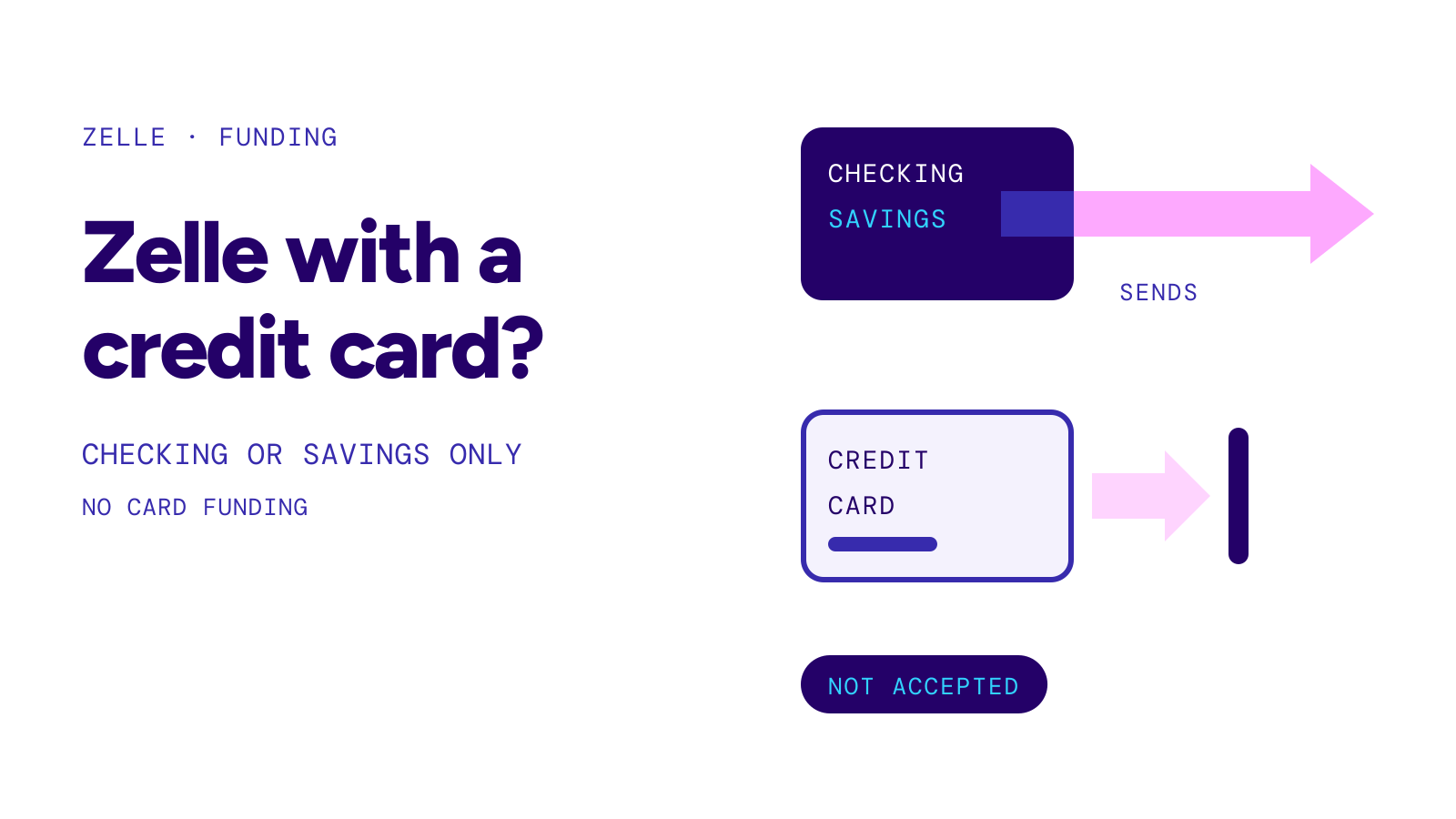
No. You cannot use Zelle with a credit card. Zelle moves money between eligible checking or savings accounts at US banks and credit unions, so a payment comes out of money you already have. Venmo, PayPal and Cash App do accept credit cards, but each charges a fee of about 3% to send money that way.
On this page
What Zelle can and cannot draw from
Zelle runs inside your bank’s app or online banking. Zelle’s own pages say that to send or receive money, both people must have an eligible checking or savings account in the US. There is no option to fund a Zelle payment from a card’s credit line.
Your bank decides which of your accounts are eligible. Chase, for example, says you need a Chase checking account: Chase savings accounts and Chase credit cards cannot be used with Zelle. Chase also says Zelle accepts Visa or Mastercard debit cards linked to US bank accounts, which is still money from a bank account, not credit.
At a glance
- Credit cardCannot be used to send with Zelle
- AccountsEligible US checking or savings accounts, as the bank allows
- At ChaseChase checking only; no Chase savings or credit cards
- FeesTypically none for consumers; Zelle tells you to confirm with your bank
Sources: Zelle: Using Zelle, Zelle Help Center, Chase: Can you use Zelle with a credit card? · Checked on October 26, 2026
Zelle’s Q1 2026 survey of participating banks and credit unions found that 99.40% of consumer checking and savings accounts linked to Zelle pay no fee to send, receive or request money.
If you need to pay with a credit card
Three payment apps let you send money to another person from a linked credit card. Each charges its own fee for it, on top of anything your card issuer charges.
| App | Fee to send from a credit card | Fee from balance, bank or debit card |
|---|---|---|
| Venmo | 3.00% | $0 |
| PayPal (Friends and Family, US) | 2.90% + $0.30 | $0 from balance or bank |
| Cash App | 3% | $0 |
Sources: Venmo fees, PayPal consumer fees (last updated May 19, 2026), Cash App Terms of Service · Checked on October 26, 2026
On a $500 payment that works out to $15 on Venmo, $14.80 on PayPal and $15 on Cash App. PayPal’s fee table lists the 2.90% plus fixed fee for cards; the fixed fee is $0.30 when the money is received in US dollars. Sending internationally adds PayPal’s and Venmo’s separate international fees.
Warning
Your card issuer may treat a payment to a person as a cash advance. Venmo says some card providers charge cash advance fees and a higher APR for these payments, and tells you to ask your card provider. Chase says sending money with a credit card is often treated as a cash advance, which may start accruing interest right away.
Venmo shows whether a linked card carries a fee: open the Me tab, go to Wallet, and tap the card under Banks and cards.
Why Zelle works this way
Chase puts it simply: with Zelle you can only send money you have available in your deposit account. A credit card lets you spend against a credit line instead, and Zelle does not connect to one.
Zelle also offers no purchase protection. Its FAQ says that if you buy something with Zelle and the item never arrives or is not as described, Zelle does not cover it, and recommends using it only with people you know and trust. Card-funded payments in the apps follow each app’s own rules; for a side-by-side look, see zelle vs venmo and zelle vs paypal.