Short answer
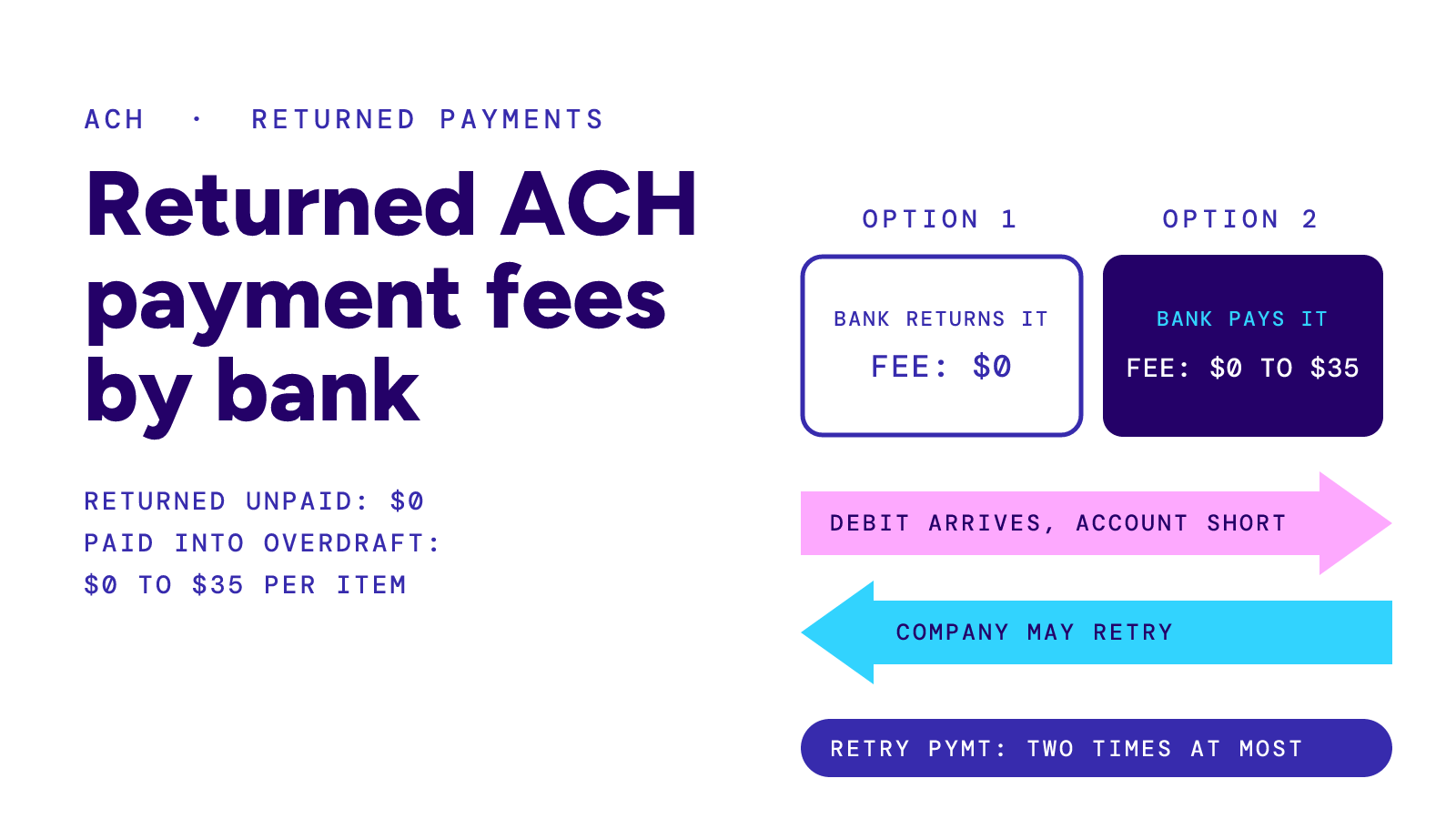
When your bank sends an ACH debit back because the account is short, the seven banks checked here charge nothing for the return. The cost comes when the bank pays the debit into overdraft instead: $0 to $35 per item, depending on the bank. The company you were paying can still add its own fee for the failed payment.
On this page
Fee sheets checked on November 27, 2026, on each bank’s own documents; the edition of each sheet is in the table.
Returned or paid: two different fees
An ACH debit that arrives when your balance cannot cover it leaves the bank with two choices. Bank of America describes it this way: at end-of-day processing, if there is not enough available money, the bank either pays the item and overdraws the account, or returns the item unpaid. The two outcomes are priced separately, and most of the cost sits on the first one.
At a glance
- Returned unpaid$0 at all seven banks below
- Paid into overdraft$35 at Wells Fargo, $20 at Navy Federal’s optional service, $15 at Santander and Huntington, $10 at Bank of America, nothing at SoFi and American Express
- Retry by the companyallowed up to two times under Nacha’s rules, and labeled RETRY PYMT
- The company’s own feeset by the company, not by Nacha or your bank
Sources: each bank’s fee sheet in the table below · Nacha, Minor Rules Topics · Nacha, ACH Network Risk and Enforcement Topics · Checked on November 27, 2026
What seven banks charge
| Bank | Returned unpaid | Paid into overdraft | Fee sheet |
|---|---|---|---|
| Wells Fargo | No fee | $35 per item; none on items of $10 or less; no more than three a business day | Consumer Account Fees and Information, effective July 28, 2026 |
| Bank of America | No fee | $10 per item (rising to $15 on February 19, 2027); no more than two a day | Personal fee schedule, page dated 11/2026 |
| Navy Federal | No charge | $20 under the optional overdraft protection service, one fee a day | Fee schedule form 2043ep (5-25) |
| Santander | $0 | $15 per item, no more than three a business day; none if the account ends up overdrawn by $100 or less | Personal Deposit Account Fee Schedule, 09/2025 |
| Huntington (Perks Checking) | None | $15 per item, only if the account ends the day overdrawn by more than $50; no more than three a day | Personal Account Charges form, 10/26 |
| SoFi | $0 | $0 | Fee sheet effective May 18, 2026 |
| American Express (Rewards Checking) | No Amex fee | Overdraft services not offered; no fee or interest on a negative balance | Rewards Checking schedule, revised October 29, 2026 |
Sources: Wells Fargo · Bank of America · Navy Federal · Santander · Huntington · SoFi · American Express · Checked on November 27, 2026
These are the standard consumer checking figures on the sheets above. A different account at the same bank can carry different fees, and a bank can change a sheet at any time; your own account agreement is the final word. Banks not listed may charge for returns.
A worked example: a $150 debit against $90
Say a utility company pulls $150 by ACH on a day your balance is $90. The account is short by $60. What it costs depends on what your bank does with the debit:
| Bank | If the debit is returned | If the debit is paid |
|---|---|---|
| Wells Fargo | $0 | $35 |
| Bank of America | $0 | $10 |
| Navy Federal | $0 | $20 if you use the optional service |
| Santander | $0 | $0, because the shortfall is under $100 |
| Huntington | $0 | $15, because the shortfall is over $50 |
| SoFi | $0 | $0 |
| American Express | $0 | Not offered |
The same $60 shortfall costs anything from nothing to $35. If it were $8 short instead of $60, Wells Fargo would charge nothing (its sheet skips overdrafts of $10 or less when the account ends the day that close), and Huntington would also charge nothing (under its $50 line).
Sources: the fee sheets in the table above · Checked on November 27, 2026
Then the company tries again
A returned debit is often not the end of it. Nacha’s rules let the company that originated the payment resubmit it, and Nacha limits reinitiation to two times. A resubmission has to carry the description RETRY PYMT in its entry description, so you and your bank can recognize it, and the new entry has to carry the same company name, company ID and amount.
What your bank does with those retries is its own policy. Bank of America is the one sheet of the seven that spells it out: it does not charge its overdraft item fee on an ACH entry labeled RETRY PYMT or REDEPCHECK, and warns that a resubmission without the label may be charged as a separate item. Wells Fargo, Navy Federal, Santander, Huntington, SoFi and American Express say nothing about retries on their sheets, so there the usual per-item rules are what you can read.
Nacha’s rules also say that an unauthorized debit cannot be fixed by reinitiating it. If a retry is for a payment you never approved, the route is a dispute, not a wait; can an ACH transfer be reversed covers the deadlines.
Sources: Nacha, Minor Rules Topics (reinitiation limited to 2 times; wording clarified effective January 1, 2019) · Nacha, ACH Network Risk and Enforcement Topics (RETRY PYMT, identical amount) · Bank of America personal fee schedule · Checked on November 27, 2026
The company’s fee is separate
None of the bank fees above includes what the company charges for a failed payment. Bank of America’s sheet says it in one line: when it declines or returns an item unpaid, “you may be charged a fee by the payee.” That amount comes from your contract or terms with the company, not from the ACH rules, so it is worth reading the terms of the biller before an autopay date you cannot cover.
Warning
A fee for a returned payment is a different thing from a late fee and from a bank’s overdraft fee. One missed payment can produce one, two or all three. Read each line on the statement and the company’s notice separately.
What to check before the debit date
- Look at the date, not only the amount. The debit lands on the day the company sets, and how long does ACH take explains the usual timing.
- Know which outcome your bank’s sheet gives you. Use the table: returned is free at these seven, paid may not be.
- Ask about the fee. Whether a bank waives or refunds an overdraft fee is its own decision, so ask before assuming either way.
- Stop or move an autopay you cannot cover. Stop automatic payments explains how and how far ahead of the date to ask.
- If the status shows pending or returned, read the code. ACH return codes explains R01 (insufficient funds) and the rest, and ACH transfer pending covers what a pending debit means.