Short answer
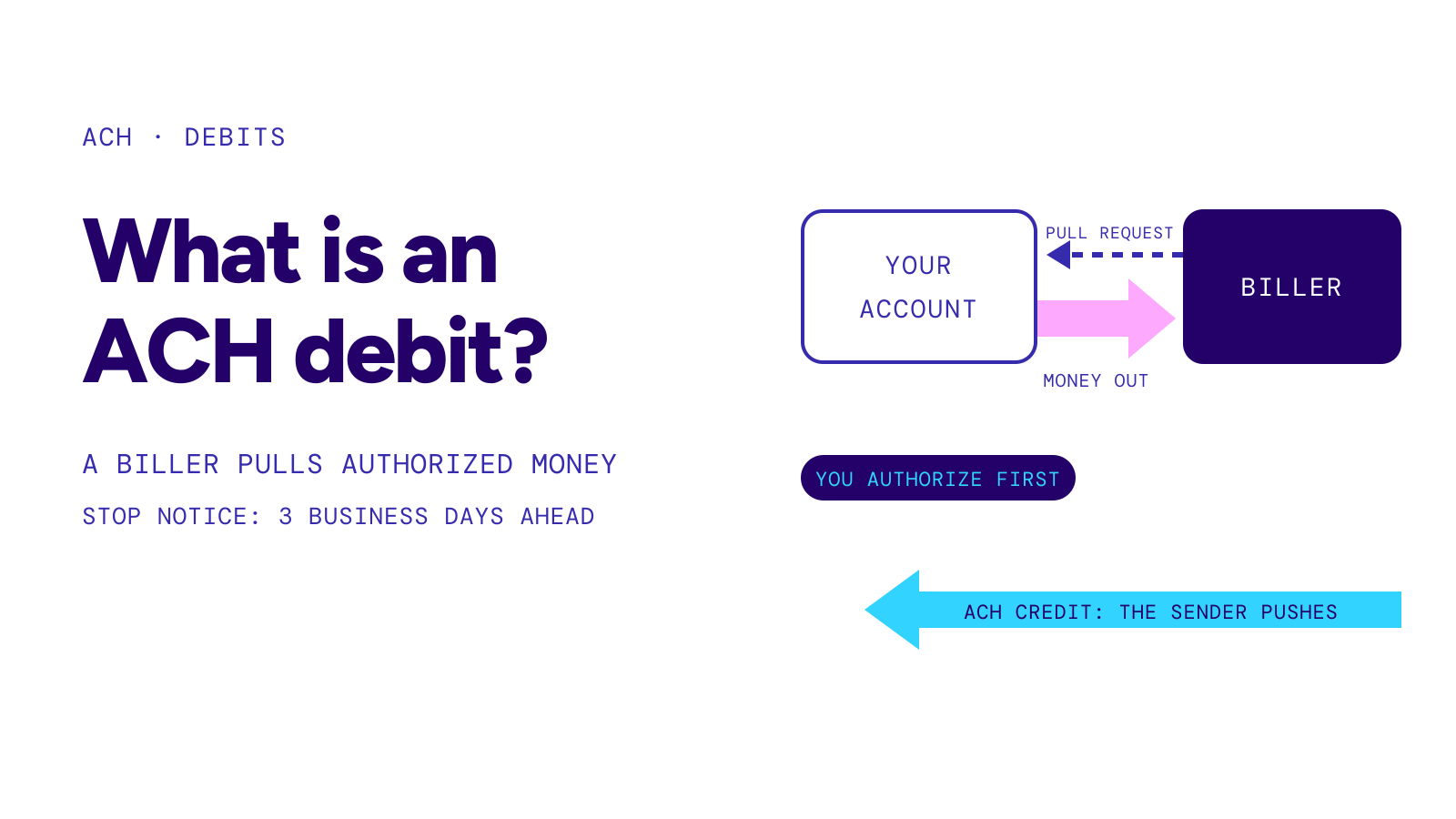
An ACH debit is an electronic payment that pulls money out of your bank account after you authorize it. A utility, lender, insurer or other biller starts the entry, and it travels through the ACH Network to your bank. An ACH credit works the other way: the sender pushes money in, as with payroll direct deposit. “Debit” describes the direction of the entry, not a debit card.
On this page
Definitions and consumer rules checked against Nacha and CFPB sources on October 31, 2026.
What is an ACH debit?
An ACH debit begins with a party collecting money from an account after the account holder has authorized it. Nacha calls this a direct payment debit application. Examples include:
- a utility company collecting a monthly bill;
- a mortgage or auto lender collecting a scheduled payment;
- an insurer collecting a premium;
- a charity collecting an authorized donation;
- a business collecting payment for a product or service.
The biller or other originator gives its bank, the Originating Depository Financial Institution or ODFI, an instruction to debit your account. The entry goes to an ACH operator, which routes it to your bank, the RDFI, and your bank takes the money from your account.
In ACH terminology, the “receiver” is the person or organization that authorized the entry, even though money is leaving that receiver’s account. That vocabulary can feel backwards if you think only about who receives the cash.
Authorization is the dividing line. A company should not simply pull money because it has your account number. Nacha’s developer guide says the originator obtains authorization from the receiver to transact against the account.
ACH debit vs ACH credit
| Question | ACH debit | ACH credit |
|---|---|---|
| Direction | Pulls authorized money from the receiver | Pushes money to the receiver |
| Who initiates the entry? | The party collecting the money | The party sending the money |
| Common consumer example | Utility bill, mortgage payment or insurance premium | Payroll direct deposit or tax refund |
| Whose authorization matters? | The account holder authorizes the pull | The sender authorizes the push |
| What you see in your account | A withdrawal or outgoing payment | A deposit or incoming transfer |
The ACH Network carries both types. Nacha describes it as a batch, store-and-forward system used for disbursements, which are credits, and collections, which are debits. For a side-by-side page focused on choosing between the two, see ACH credit vs ACH debit.
Typical ACH credits include wages deposited by an employer, Social Security and other government payments, tax refunds, and a transfer you push from one bank account to another. If an incoming entry is missing, the ACH trace number guide explains what to ask the sender for.
How long does an ACH debit take?
The words “credit” and “debit” identify direction. They do not, by themselves, tell you whether the payment is Same Day ACH or future-dated. Nacha says ACH entries can be processed on a same-day basis or scheduled for a future date.
The originator’s timing, the file window, the settlement date and the receiving bank’s posting rules all matter. See how long does ACH take for settlement and availability, Same Day ACH for the network windows and Federal Reserve holidays for days when ordinary ACH settlement pauses.
A pending debit can be an authorization or a submitted collection that has not settled. The ACH transfer pending guide lists the first checks.
Stopping a recurring ACH debit
For a preauthorized recurring electronic fund transfer from a consumer account, federal Regulation E gives a consumer the right to stop payment by notifying the financial institution at least three business days before the scheduled date.
The notice can be oral or written. The institution may require written confirmation, but it must tell you about that requirement and give you an address. If written confirmation is required and does not arrive within 14 days of the oral notice, the stop-payment order can cease to bind the institution.
Stopping the bank transfer does not necessarily cancel the contract or erase the bill. You may still owe the merchant, lender or service provider. Tell the company that you are revoking authorization and ask how any remaining balance should be paid. Our step-by-step guide to stopping automatic payments separates the merchant notice from the bank stop-payment request.
Returns and unauthorized debits
An ACH debit can be returned for reasons such as insufficient funds, a closed account or an authorization dispute. The return reason is identified by a code. The ACH return codes guide explains common codes including R01, R02 and R10.
If you do not recognize a debit, contact your bank promptly. Do not assume that the company name in the statement will exactly match the name you know; ask the bank for the full ACH entry details. An unauthorized-debit dispute has deadlines and evidence requirements that depend on the account and transaction, so the bank’s dispute process is the next practical step.
For reversal rules and limited error cases, see Can an ACH transfer be reversed?.