Short answer
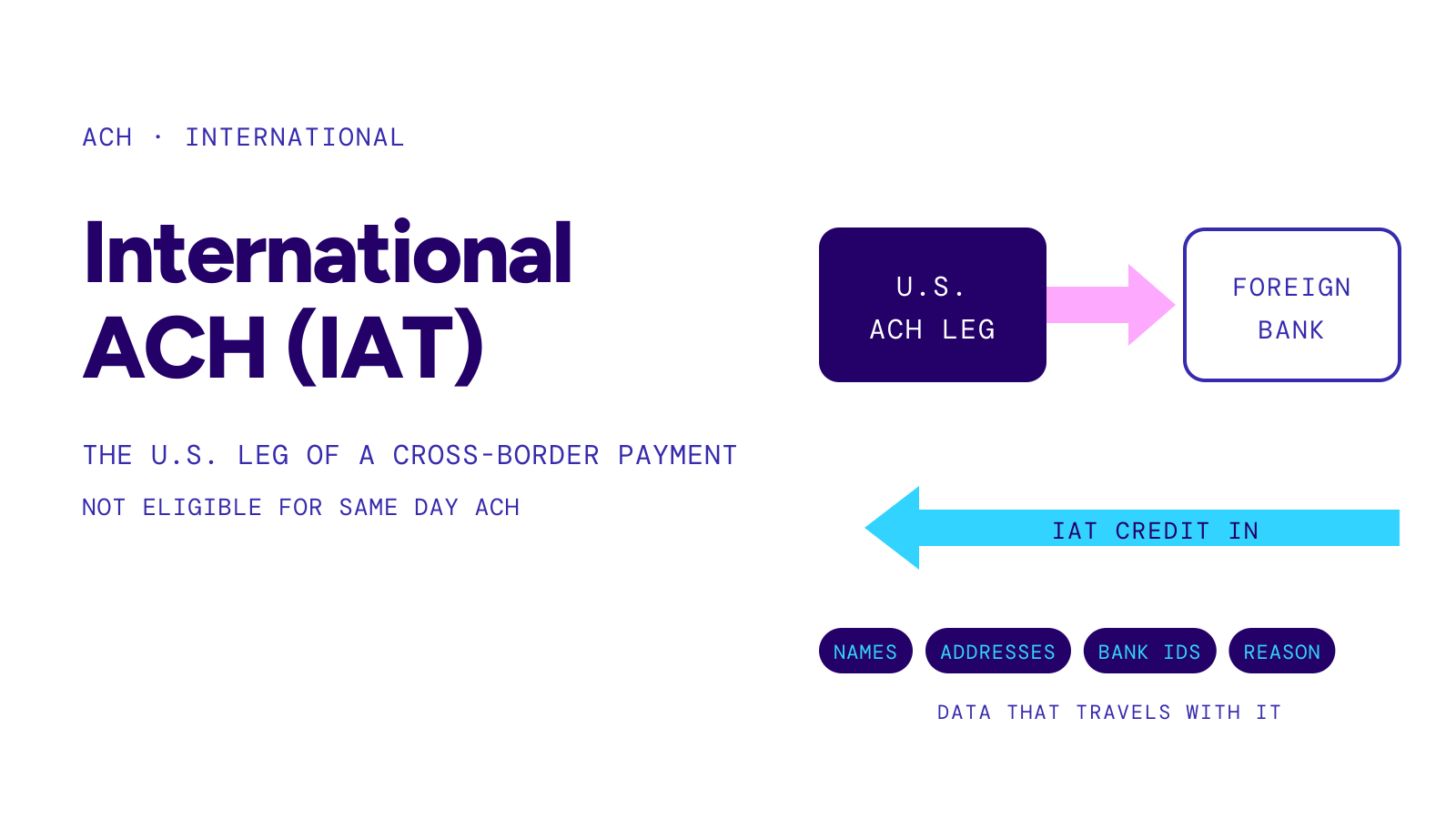
An international ACH transaction, or IAT, is the U.S. ACH Network part of a payment that involves a financial agency outside the United States. IAT is an ACH entry format with extra information about the parties and banks involved. It is not a separate global payment network, and an IAT entry cannot use Same Day ACH.
On this page
At a glance
- Where it runsThe U.S. portion runs on the ACH Network
- What makes it internationalA foreign financial agency is involved in the payment flow
- Entry typesConsumer or corporate, credit or debit
- Same Day ACHNot eligible
- What to ask before sendingRoute, currency conversion, fees, delivery estimate and return policy
Sources: Nacha’s IAT definition, Nacha’s IAT overview and the Federal Reserve Financial Services IAT FAQ. Checked October 29, 2026.
What the IAT label actually means
An international ACH transaction is not an ACH payment that travels unchanged from a U.S. account to a bank account anywhere in the world. ACH is a U.S. network. The IAT format identifies the ACH leg of a wider international payment when the payment involves an account or facility of a financial agency outside the United States.
Nacha revised the formal definition effective September 18, 2026. The current rule focuses on whether the ACH entry is part of a payment involving a foreign financial agency. Our news report on the IAT definition change covers the rule update itself. This guide focuses on how to recognize the format and what to check before using a bank or transfer service.
The distinction matters because a service can collect money through ACH in the United States and complete delivery through another rail abroad. Your statement may show an ACH debit, while the recipient gets a local bank transfer in another currency. The IAT record supplies information needed for screening and tracing the U.S. ACH component; it does not describe every step after the money leaves that component.
What information travels with an IAT entry
The Federal Reserve’s IAT FAQ lists the data an IAT entry carries: the names and addresses of the originator and the beneficiary; the name, identification number and branch country of the originating bank, any foreign correspondent bank and the receiving bank; the reason for the payment; and indicators used for OFAC sanctions screening.
That is more information than appears in a basic domestic ACH entry. It gives participating U.S. banks data they need for sanctions screening and other compliance checks. It does not guarantee that a payment will pass screening, arrive by a quoted time or avoid an intermediary fee.
The sender usually does not build the IAT file manually. A bank, payroll provider or transfer service collects the required details and creates the entry. Still, the sender is responsible for giving accurate beneficiary and payment information. A misspelled legal name, incomplete address or wrong account identifier can delay or reject the wider payment even if the U.S. debit succeeds.
Credits, debits, consumers and businesses
The Federal Reserve’s IAT FAQ says the format supports consumer and corporate credits and debits. That covers several possible directions:
| Example | U.S. ACH leg | Wider payment |
|---|---|---|
| U.S. sender pays a person abroad | Debit or credit, depending on the provider’s setup | Funds continue through a foreign bank or local payment system |
| Foreign sender pays a U.S. recipient | IAT credit to the U.S. account | Funding originates through a foreign financial agency |
| Business collects or pays internationally | Corporate IAT debit or credit | Service handles the cross-border route and required data |
The table describes possible structures, not a promise that every bank offers every type. Ask the provider how it will initiate the payment and what will appear on both statements.
IAT is not Same Day ACH
Nacha’s definition of IAT entries says an IAT entry cannot be a Same Day Entry. A provider may still advertise a fast international transfer, but that speed can come from its own funding model, prefunding or the foreign delivery rail. Do not interpret a fast quote as Same Day ACH eligibility.
For ordinary domestic entries, see our guide to same day ACH. It explains the U.S. processing windows and limits that do not apply to IAT entries in the same way.
The delivery estimate for an international payment can include several clocks: when the U.S. account is debited, when the provider receives final funds, when it performs screening, when currency is converted and when the foreign bank posts the credit. Ask which event the quoted time refers to.
International ACH vs a wire transfer
IAT and a wire transfer are different payment methods. An IAT uses the ACH Network for the U.S. entry. A wire is sent through a wire network and usually has a separate fee, message format and handling process.
| Question | IAT or ACH-funded transfer | International wire |
|---|---|---|
| U.S. payment rail | ACH Network for the IAT leg | Wire network |
| Same-day ACH eligibility | No | Not an ACH payment |
| Data and screening | IAT addenda support party and bank information | Wire message carries its own payment and party data |
| Reversal or return | Governed by ACH rules for the ACH entry, plus provider terms | Usually difficult to recall once released |
| Final delivery | May use another rail abroad | Usually proceeds through correspondent or direct banking relationships |
A bank may offer both choices. Compare the complete price, exchange rate, expected arrival, recipient-bank deductions and what happens if the account details are wrong. Our comparison of ACH vs wire transfer explains the domestic rail differences in more detail.
Consumer protections still depend on the transaction
The Federal Reserve’s IAT FAQ says the reason-for-payment information in an IAT entry supports Regulation E. Whether Regulation E covers a given payment still depends on the transaction: it applies to consumer electronic transfers, not to business payments, and it does not turn every international transfer into a refundable one.
If you see an IAT debit you did not authorize, contact your bank promptly and describe the entry exactly as it appears. Keep the amount, date, company name and trace information. If the payment was made through a transfer service, also open a case with that service, but do not wait for it before notifying your bank.
For a payment you authorized but sent with wrong recipient details, the issue is different. Ask the provider whether it can stop or amend the transfer and whether the foreign leg has already been released.
A practical checklist before sending
- Confirm the legal recipient name. Match the name to the destination account and the provider’s instructions.
- Check the destination identifiers. Depending on the country, you may need an IBAN, local account number, bank code or SWIFT/BIC.
- Ask how the payment is funded. Find out whether your U.S. account will be debited by IAT, another ACH format or a card transaction.
- Price the whole route. Compare the visible fee, exchange-rate markup and possible recipient or intermediary deductions.
- Define the delivery estimate. Ask whether it means debit, conversion, release or final posting.
- Read the return policy. Know what happens if the destination data is invalid or screening stops the payment.
- Save the confirmation. Keep the provider’s reference and the ACH trace number if one is supplied. Our ACH trace number guide explains what that number can and cannot locate.