Short answer
An ACH transfer is pending because the payment moves in batches to an ACH Operator, the Federal Reserve or The Clearing House, which settles only at fixed times on banking days. Nacha says debits settle the same or the next banking day and credits within two banking days, and about 80% of all ACH payments settle in one banking day or less. Since September 18, 2026, a regular ACH credit must be available by 9:00 AM local time at the receiving bank on the settlement date.
On this page
Weekends, the four federal holidays left in 2026 and your own bank’s cutoff each push that date further out. A pending debit can also come back instead of completing, and the return code says why.
At a glance
- Why it is pendingACH is batched and settles at fixed times on banking days only
- Typical settlementSame or next banking day for debits, up to two banking days for credits
- Regular credit available by9:00 AM on the settlement date, receiving bank’s local time
- Weekends and federal holidaysNo settlement
- Same Day ACH limit$1 million per payment
- Most return deadlinesOpening of business on the second banking day after settlement
Sources: Nacha: How ACH Payments Work · Nacha: Funds Availability Requirements for Non-Same Day Credit Entries · Nacha: Limitation on Warranty Claims · Checked on September 27, 2026
Why an ACH transfer is pending
Your bank does not send an ACH payment on its own. It collects payment files and passes them to an ACH Operator, and there are two of them, the Federal Reserve and The Clearing House; the receiving bank (the RDFI) then places the money in the account (Nacha). Because the files move on a schedule and the network has to screen for fraud and money laundering, the CFPB says ACH “payments can take days to complete”, even ones entered on a business day (CFPB). Settlement runs only while the Federal Reserve’s National Settlement Service is open, so nothing settles on weekends or federal holidays (Nacha).
The sending side has its own clock, set by the bank rather than by the network. Bank of America debits a domestic transfer on the business day you direct it to start processing, and its ACH cutoff is 8:00 PM ET (Bank of America online banking service agreement, effective August 27, 2026). At Ally Bank, a standard transfer requested before 1:00 AM ET on a weekday takes three business days and a next-day transfer requested before 7:30 PM ET takes one; Ally also warns that a request made on a weekend or holiday may take extra time (Ally Bank). Those are each bank’s published schedules, not network rules, so read your own bank’s transfer page, or find it in our bank pages.
How long ACH pending lasts
Nacha’s rules bound the wait. Debits settle the same banking day or the next one, and an ACH debit cannot carry a settlement date more than one banking day into the future. Credits can settle the same day, the next banking day or in two banking days, and Nacha estimates that 80% of all ACH payments, credits and debits together, settle in one banking day or less.
Source: Nacha: How ACH Payments Work · Checked on September 27, 2026
Same Day ACH is the fast lane. At the Federal Reserve as ACH Operator, same-day-eligible files sent by 10:30 AM, 2:45 PM and 4:45 PM ET settle at 1:00 PM, 5:00 PM and 6:00 PM ET the same day; everything else settles at 8:30 AM ET on the later of the next banking day or the settlement date (FedACH processing schedule). Same Day ACH currently carries a limit of $1 million per payment, and an entry above it is not rejected but processed for next-day settlement instead (Nacha). Nacha has adopted a rise to $10 million per payment effective September 17, 2027, which is not in force today (Nacha).
From sending to available funds
Timeline
- Before your bank’s cutoffyou submit the transfer and it joins your bank’s next ACH file (8:00 PM ET at Bank of America, 7:30 PM ET for Ally’s next-day transfer)
- Same banking dayyour bank sends the file to an ACH Operator, the Federal Reserve or The Clearing House
- 8:30 AM ET on the settlement datea non-Same Day entry settles, on the later of the next banking day or the settlement date
- By 9:00 AM, receiving bank’s local timethe credit must be available to withdraw
Sources: FedACH processing schedule · Nacha: Funds Availability Requirements for Non-Same Day Credit Entries · Bank of America service agreement · Ally Bank · Checked on September 27, 2026
When an ACH deposit becomes available
Since September 18, 2026, a receiving bank must make a non-Same Day ACH credit available for withdrawal no later than 9:00 AM on the settlement date, measured in the receiving bank’s own local time, not in ET. Nacha’s announcement of the change says the 9:00 AM deadline applies to all non-Same Day ACH credits whatever time the bank receives them from its ACH Operator (Nacha rule, Nacha, September 1, 2026). Older charts still show a condition about credits received by 5:00 PM the previous day; that condition is gone.
One exception took effect on the same day. For banks located east of the Atlantic Time Zone and west of the International Date Line, such as Guam and the Northern Mariana Islands, a non-Same Day credit arriving after 8:00 AM local time on the settlement date must be available by the end of the settlement date, or by 9:00 AM the next banking day if it arrives after the bank’s processing is complete (Nacha).
Same Day credits have their own deadlines, in the receiving bank’s local time: 1:30 PM for the first window, 5:00 PM for the second, and the end of the processing day for the third (Nacha chart, Nacha Phase 3 rule). A bank that reasonably suspects a credit is unauthorized is exempt from those deadlines and must promptly notify the sending bank. Underneath all of it sits Regulation CC: funds received by electronic payment must be available for withdrawal no later than the business day after the banking day the bank received them (12 CFR 229.10).
Weekends and the remaining 2026 Fed holidays
| Holiday | Date | FedACH processing ends | Processing resumes |
|---|---|---|---|
| Columbus Day | October 12, 2026 | October 10, 3:00 AM ET | October 12, 5:30 PM ET |
| Veterans Day | November 11, 2026 | November 10, 11:30 PM ET | November 11, 5:30 PM ET |
| Thanksgiving Day | November 26, 2026 | November 25, 11:30 PM ET | November 26, 5:30 PM ET |
| Christmas Day | December 25, 2026 | December 24, 11:30 PM ET | December 27, 5:30 PM ET |
Sources: Federal Reserve holiday schedules · 2026 holiday schedule for FedACH Services, December 16, 2025 · Checked on September 27, 2026
Processing restarts on the evening of the holiday, but nothing settles on the day itself. Count the effect on your own transfer: a next-day credit sent on Friday, October 9 by your bank’s cutoff cannot settle on Saturday, Sunday or Columbus Day, so its earliest settlement date is Tuesday, October 13. Nacha adds that bill payments due over a weekend or holiday are collected on the next banking day, which works in the payer’s favour (Nacha).
Common ACH return codes
| Code | What it means | Return deadline |
|---|---|---|
| R01 | Insufficient funds: the balance does not cover the debit | 2 banking days |
| R02 | Account closed | 2 banking days |
| R03 | No account, or the account could not be located | 2 banking days |
| R04 | Invalid account number structure | 2 banking days |
| R07 | The customer revoked the authorization given to the originator | 60 calendar days, written statement |
| R08 | Payment stopped by the customer | 2 banking days |
| R09 | Uncollected funds | 2 banking days |
| R10 | Customer says the originator is unknown or not authorized to debit | 60 calendar days, written statement |
| R11 | An authorization exists, but the debit did not follow its terms | 60 calendar days, written statement |
Sources: code definitions and the two-banking-day deadlines from CBS Bank’s quick reference to the Nacha return reason codes; R10 and R11 from Nacha: Differentiating Unauthorized Return Reasons; the 60-day window from Nacha: Limitation on Warranty Claims · Checked on September 27, 2026
The general Nacha deadline is the opening of business on the second banking day after the original entry’s settlement date. An unauthorized debit to a consumer account gets a longer window: the opening of business on the banking day after the 60th calendar day following settlement, with a Written Statement of Unauthorized Debit. A non-consumer account does not get that window; for a business account the deadline stays at the second banking day (Nacha). Neither R10 nor R11 covers a dispute about goods and services (Nacha).
A returned debit can sometimes come back. Nacha requires a permitted resubmission to carry “RETRY PYMT” in the company entry description, and says that “an unauthorized debit cannot be remedied” by reinitiating it (Nacha). People’s Bank, describing the rules to its customers, states that only entries returned for insufficient or uncollected funds may be re-presented, with a limit of two re-presentments within 180 days of the original entry date, plus a stop-payment return if the receiving party approves (People’s Bank, January 2024).
Regulation E rights for an unauthorized debit
If a pending or posted ACH debit was not authorized, or the amount or date is wrong, Regulation E treats it as an error. Notice has to reach your bank no later than 60 days after it sent the statement that first shows the item. The bank then has 10 business days to determine whether an error occurred, or up to 45 days if it provisionally credits your account within those 10 business days, and it must correct a confirmed error within one business day of deciding. For an account open less than 30 days the periods are 20 business days and 90 days. The bank may require written confirmation of an oral notice within 10 business days (12 CFR 1005.11). Reporting an unauthorized transfer shown on a statement within 60 days also protects you from liability for later transfers (12 CFR 1005.6).
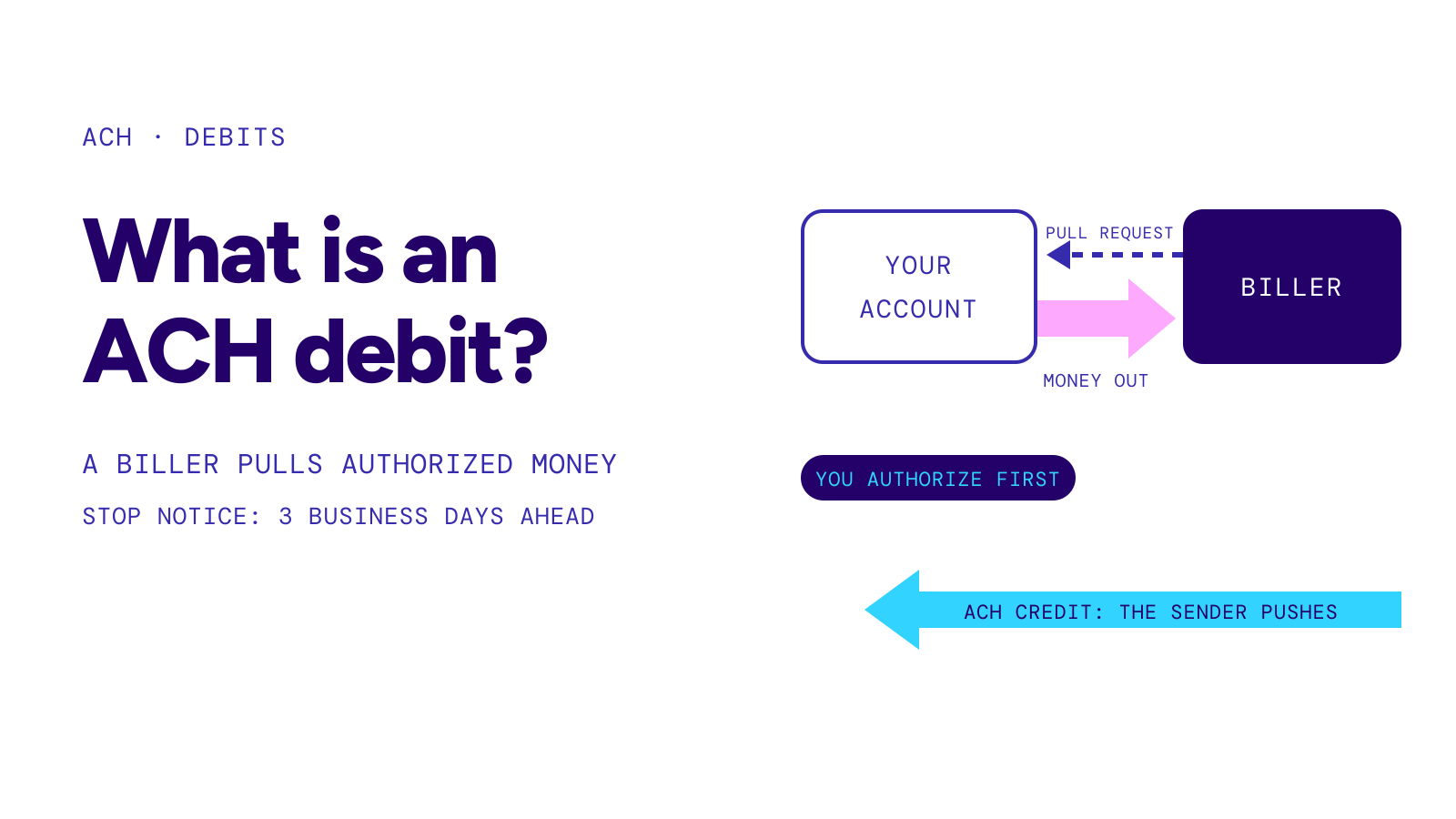
To stop a debit that has not happened yet, you can order a stop payment orally or in writing at least three business days before the scheduled date; an oral order stops binding after 14 days if the bank asked for written confirmation and did not get it. A recurring debit must be authorized in writing, and when a preauthorized debit varies in amount you are owed written notice of the amount and date at least 10 days ahead (12 CFR 1005.10). The CFPB adds that you may stop a company from taking automatic payments even if you allowed them before, that payments taken after you revoke authorization are errors you can ask your bank to refund, and that banks generally charge a fee for a stop-payment order (CFPB).
Warning
Cancelling an automatic payment does not cancel the debt. The CFPB says that if you stop an automatic payment on a loan, you still have to pay by another method.
This page explains how ACH transfers work. It is not financial advice.