Short answer
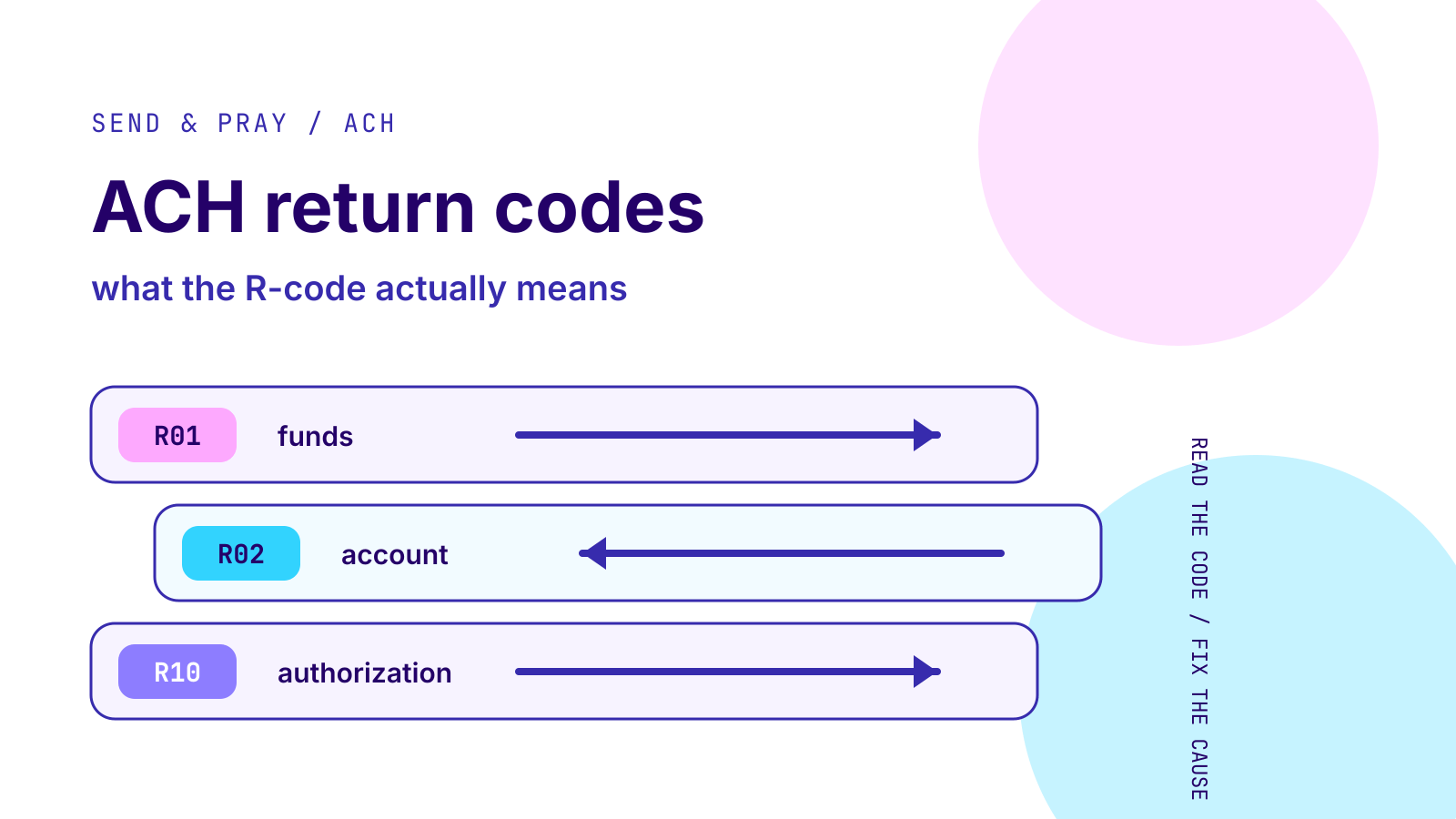
ACH return codes are the bank’s short explanation for why an entry came back. They are not all the same kind of failure: R01 points to available funds, R02–R04 point to account details, and R10 or R11 can signal a consumer dispute.
On this page
This guide covers the codes people and small businesses are most likely to meet, what each code means, and what to do next. It is based on Nacha’s return guidance, Nacha’s 2025 operations bulletin, and BMO’s U.S. ACH return-code table. Source pages were checked October 16, 2026.
The short version
| Code | Plain-English meaning | Usual response |
|---|---|---|
| R01 | Not enough available money | Add funds or use another payment method; ask before retrying |
| R02 | Account closed | Get new account details |
| R03 | No account or the bank cannot match it | Recheck the routing number, account number and recipient name |
| R04 | Invalid account-number structure | Correct the account number before sending again |
| R07 | Customer revoked authorization | Do not debit again without a new authorization |
| R10 | Customer says the debit was not authorized | Stop collection and investigate the authorization |
| R11 | Debit was authorized, but did not match the authorization | Correct the amount, date or other defect before any new entry |
The return code tells the sender what the receiving bank reported. It does not prove who made the underlying mistake, and it does not replace the bank’s case record.
R01: insufficient funds
R01 means the receiver’s available balance was not enough to cover the debit. This is different from R09, which is used when the ledger balance may be sufficient but some of the money is not yet collected or available.
A sender should not treat R01 as permission to keep trying indefinitely. Ask the customer when funds will be available or offer another way to pay. If the entry will be submitted again, keep the original authorization and follow the bank’s and Nacha’s rules for reinitiated entries.
R02, R03 and R04: account problems
These three codes often look similar on a payment dashboard, but the fix is different.
- R02 — Account closed: the account used to be active and is now closed. The recipient needs to provide another account.
- R03 — No account or unable to locate account: the number has a valid structure, but the bank cannot match it to an open account for the named receiver.
- R04 — Invalid account number: the number itself is structurally invalid, such as having the wrong number of digits.
Nacha groups R02, R03 and R04 as administrative returns. Its 2025 bulletin says receiving banks can use Same Day ACH windows for these returns; the original payment does not have to have been a Same Day ACH entry. Faster return processing can shorten the time before the sender learns that the account information will not work.
Before sending a replacement, verify the routing number, account number, account type and recipient name. Do not guess at a single digit.
R07: authorization revoked
R07 means the receiver previously gave authorization for the debit and then revoked it. For a consumer debit, BMO’s table lists a 60-calendar-day return timeframe.
The practical point is simple: a past authorization is no longer enough. The originator should stop debiting the account and resolve the customer’s instruction. Any new debit needs a valid new basis; changing the amount or description does not cure a revoked authorization.
R10 and R11: unauthorized versus wrong terms
R10 and R11 answer different questions.
R10 is used when the customer says the debit was not authorized. R11 is used when an authorization and a relationship existed, but the entry did not match the authorization—for example, the wrong amount or an incorrect date.
Nacha repurposed R11 specifically to separate these cases. Its rule page says R11 requires the receiving bank to obtain a written statement of unauthorized debit, uses a 60-day return timeframe and does not cover disputes about the quality of goods or services. Nacha permits a corrected new entry without obtaining a new authorization when the underlying R11 error is fixed. The new entry must be originated within 60 days of the settlement date of the R11 return and remains subject to the originator’s authorization warranties.
For a sender, the distinction matters. R10 calls the authorization itself into question. R11 points to a defect in how an authorized debit was executed.
Why the return may arrive quickly—or not
Many ordinary administrative and funds-related returns use a two-banking-day window. Some consumer disputes use an extended 60-calendar-day window. The exact window depends on the code, account type and entry type.
A bank can also return an eligible entry through a Same Day ACH window. Nacha says returns are not charged the Same Day Entry fee, are not limited to original Same Day ACH payments, and do not have to wait until the original entry’s settlement date. That explains why one failed debit may come back the same day while another appears later.
For a broader timing view, see how long ACH takes and why an ACH transfer can stay pending.
What to do after an ACH return
- Read the actual R-code. “Failed” or “rejected” is not specific enough.
- Match the remedy to the code. Adding funds will not fix a closed account; a new account number will not resolve a revoked authorization.
- Contact the right party. Consumers should start with their bank for an unfamiliar debit. Businesses should work with their originating bank or payment provider.
- Preserve the authorization and notice trail. That record matters most for R07, R10 and R11.
- Do not keep retrying blindly. Reinitiated entries have their own limits and formatting requirements.
- Confirm the replacement before sending. Recheck account details and the terms of any new authorization.
If a transfer is still moving rather than formally returned, use the ACH transfer reversal guide before assuming that a return code will appear.
These are ACH network return windows, not a single promised date for every bank investigation or account credit.