Short answer
Form 1099-DA is the IRS form a US crypto broker sends you, and the IRS, after you sold, swapped or spent crypto through it. It shows gross proceeds and, for crypto you bought from 2026 on and kept at that broker, your cost basis. You owe the tax reporting whether or not a form arrives, and a wrong form is fixed by the broker named as “Filer”, not by the IRS.
On this page
At a glance
- Who sends ita US broker that effected the sale for you; for 2025 an exchange based outside the US generally does not
- You get one if youtraded crypto for other crypto, sold it for dollars, spent it on goods or services, or paid the broker’s fees in crypto
- Proceeds reportedsales on or after January 1, 2025
- Cost basis reportedonly for sales of crypto acquired after 2025 and held at that broker
- No form in the mailyou still report every gain and loss on your return
Source: IRS: About Form 1099-DA · IRS: Digital assets · Checked on November 25, 2026
What triggers a 1099-DA
The IRS lists four ways to land on a Form 1099-DA, all of them a disposition of crypto through a broker:
- Crypto for other crypto: a trade of one digital asset for another.
- Crypto for dollars: a sale for US dollars or other currency, which is the step in how to cash out crypto.
- Crypto for goods or services: paying for property or services in any amount.
- Fees: paying a broker’s transaction costs with crypto.
Buying crypto with dollars and holding it is not on that list. A broker also has to be the one that took possession of your coins: the IRS says the final rules do not cover decentralized or non-custodial brokers that never hold the assets being sold.
Source: IRS: About Form 1099-DA · IRS: Digital assets · Checked on November 25, 2026
Why cost basis can be blank
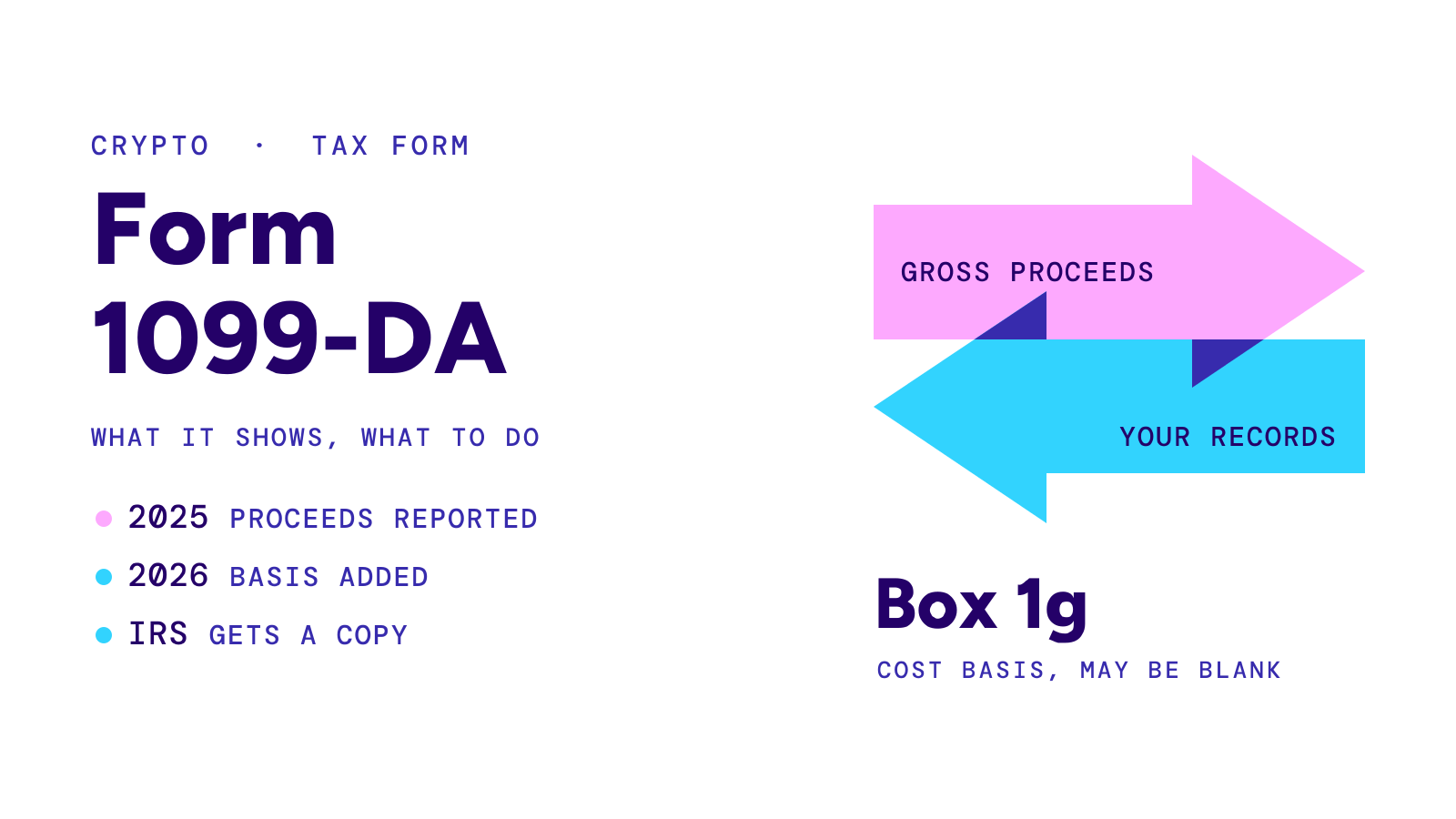
Brokers had to report gross proceeds for sales from January 1, 2025. Reporting your cost basis (what you paid) starts with sales of crypto acquired after 2025, and only if you bought it in an account where the broker held it for you and it stayed there until the sale. The instructions call that a covered security. Everything else is a noncovered security: crypto bought before 2026, or moved in from another wallet or exchange.
If box 1g (cost or other basis) is blank, the IRS says you need to work out your basis from your own books and records. If box 1g has any entry, including zero, the broker has reported that figure to the IRS.
The IRS instructions give one example. A customer buys the same asset in April 2022, April 2026 and August 2026, then sells everything in one trade in June 2027. The broker reports that single sale on three separate Forms 1099-DA: the August 2026 units as short-term, the April 2026 units as long-term, and the April 2022 units as noncovered. A single sale can therefore come with several forms.
Source: IRS: Instructions for Form 1099-DA (2026) · IRS: Form 1099-DA recipient instructions · Checked on November 25, 2026
What the boxes show
| Box | What it shows |
|---|---|
| 1b | The name of the digital asset sold |
| 1c | How many units were sold, exchanged or otherwise disposed of |
| 1d | The date you acquired it; may be blank if it was bought on many dates or the date was unknown |
| 1e | The date of the sale or disposition |
| 1f | Total proceeds, which may include cash, the value of services, other crypto or other property |
| 1g | Cost or other basis; may be blank for noncovered crypto |
| 2 | If checked, the basis in box 1g has been reported to the IRS |
| 6 | Whether the gain or loss is short-term, long-term or ordinary |
| 8 | If checked, you gave the broker acquisition information and it relied on it |
| 9 | If checked, the crypto sold was a noncovered security, and boxes 1d, 1g, 1h, 1i, 2 and 6 may be blank |
| 12a and 12b | The units transferred into an account at the broker, and the date of the transfer |
| 4 | Backup withholding, if any |
Source: IRS: Form 1099-DA, Instructions for Recipient · Checked on November 25, 2026
What to do when it arrives
- Match it to your records. Compare box 1c (units), 1e (date) and 1f (proceeds) with your own transaction history.
- Fill in what is blank. For a missing basis in box 1g, use your own purchase records.
- Answer the digital assets question on Form 1040. The form’s instructions say that if you received a Form 1099-DA you generally sold, exchanged or otherwise disposed of a digital asset and should check “Yes”.
- Report the sales. The “applicable checkbox on Form 8949” on the form tells you where each transaction goes on Form 8949 and Schedule D.
- File on time. The IRS says to use the form and your other records to report your income, and not to wait on a correction.
Warning
If a 1099-DA is wrong, or you got one you should not have, contact the issuer shown as “Filer” in the top left corner of the form and ask for a corrected form. The IRS says it cannot correct a Form 1099-DA, so do not contact it for this. Keep a copy of the original form and all correspondence, and do not delay filing.
Source: IRS: Understanding your Form 1099-DA (reviewed November 19, 2026) · IRS: About Form 1099-DA · Checked on November 25, 2026
For the 2025 transactions the IRS has told brokers it will not penalize failures to file and furnish the form if they made a good-faith effort to do both correctly and on time, which is one more reason to check yours against your own records. Moving coins between wallets is a different subject: see how to send crypto safely.